
Empty Seats, Real Losses
Rami Saab shares why effective hiring requires different strategies for different roles, especially when it comes to finding top specialized talent.

Join us as we recap the biggest highlights from Viaka and our global network—covering key events, exciting member milestones, and major industry news. Stay in the loop and be part of the journey!
In this month’s newsletter:
New Members: We welcome 9 new members to the Viaka Angel Network.
Upcoming Events: This June, join us for two events in New York City: a Women Founders & Funders Breakfast co-hosted with Ramp on June 2, and a Viaka Networking Event & Fireside Chat at EY featuring Omar Darwazeh and Rana Al-Hallaq on June 3.
May Recap: This month, we brought together founders, investors, and operators through three events: the Toronto Mixer & Fireside Chat, a Virtual Consumer & AI Demo Day, and the conclusion of our four-part Angel Investing Series.
The Viaka Podcast: In this episode, Karim Jouini, co-founder of Expensya, shares his journey building Expensya into a global SaaS company, discussing entrepreneurship, scaling, leadership, and the future of technology and business.
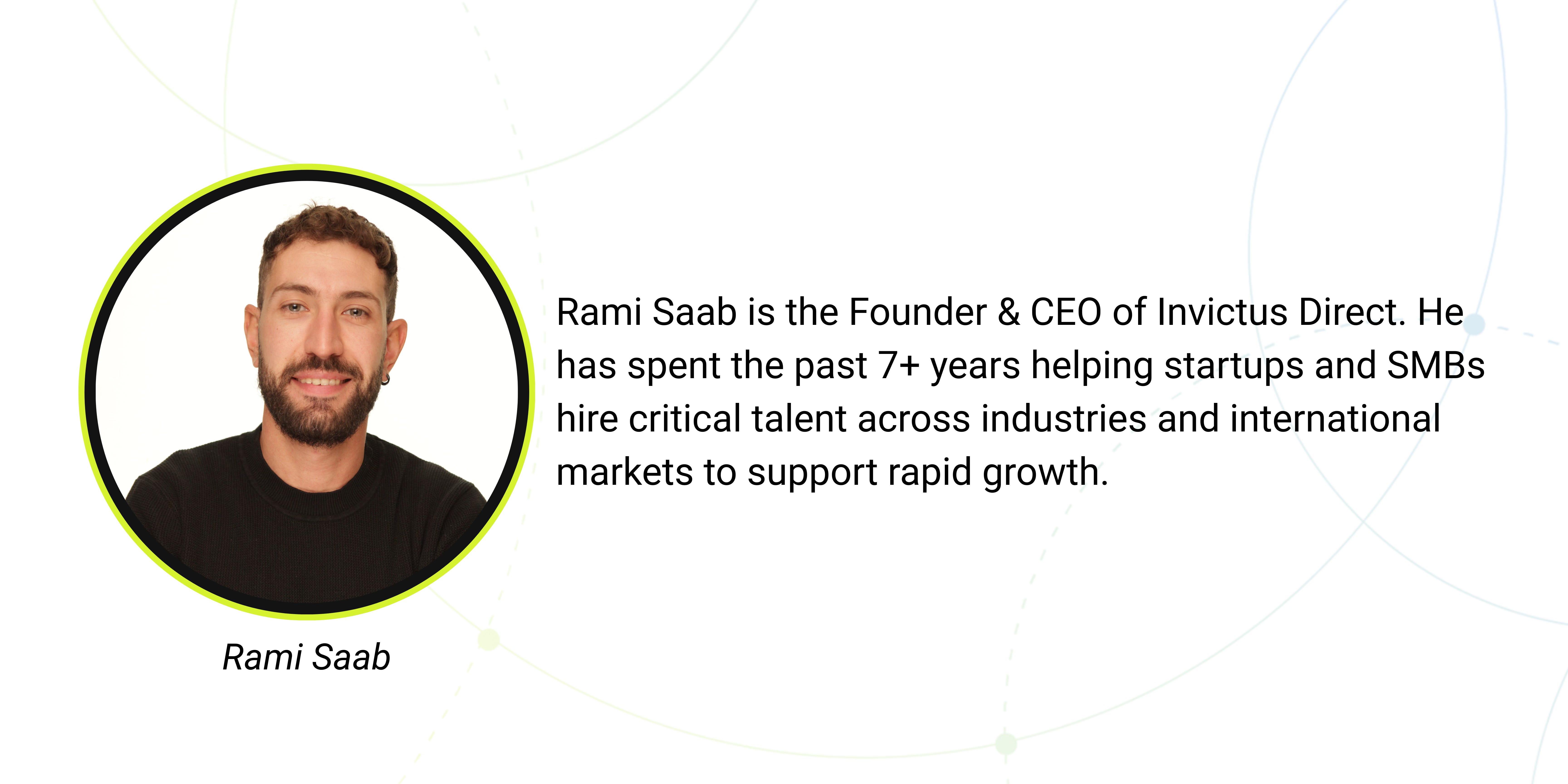
Empty Seats, Real Losses: Rami Saab, Founder & CEO at Invictus Direct, explains how hiring the right talent isn’t about using the same strategy every time.
New Members Join The Viaka Angel Network



Unlock capital access and foster meaningful connections within our rapidly growing global network — join the Viaka Angel Network today.
Upcoming Events & Gatherings
Whether you are looking to sharpen your investment strategy or connect with founders at the frontier of AI, we have a packed calendar of virtual and in-person sessions.
Women Founders & Funders Breakfast (June 2): Registration closed.
New York City (June 3): An evening hosted at EY, featuring Omar Darwazah and Rana Al-Hallaq, moderated by Arda Ural, for a conversation on investing, scaling companies, and navigating today’s market. Register here.
MENA Rising NYC Conference 2026 (Oct 14): Early Bird registration is open. Book your tickets now. If you’re a Viaka member, email razan@viaka.net to get your discount.
Our events calendar is continuously updated with new conversations, networking opportunities, and community gatherings. Check it out.
May Recap
This month, we convened founders, investors, and industry leaders through a series of engaging events centered around innovation, growth, and venture building. Highlights included:
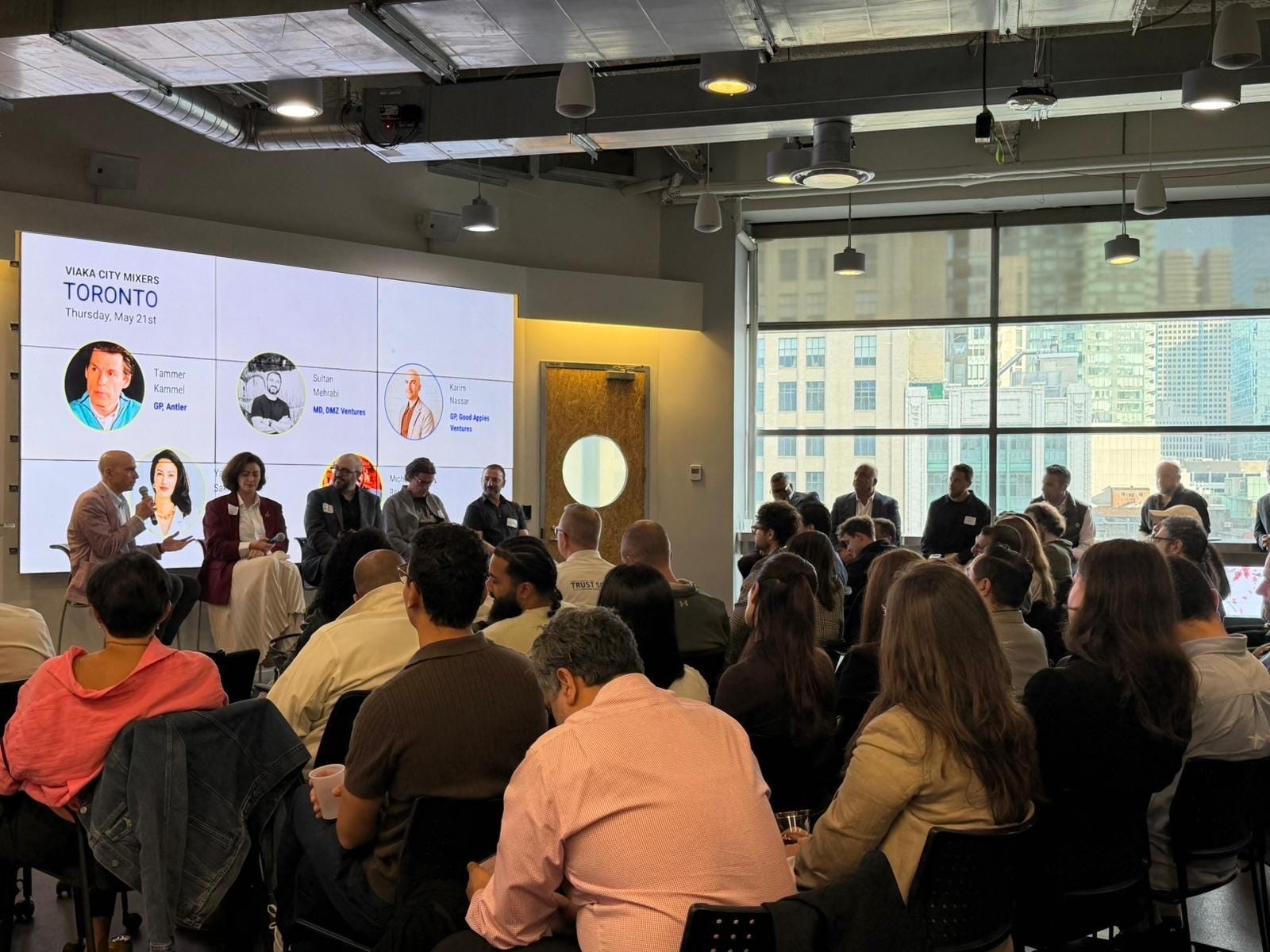
Toronto Mixer & Fireside Chat on The Blind Side of Building: The Risks Founders Overlook as They Scale.
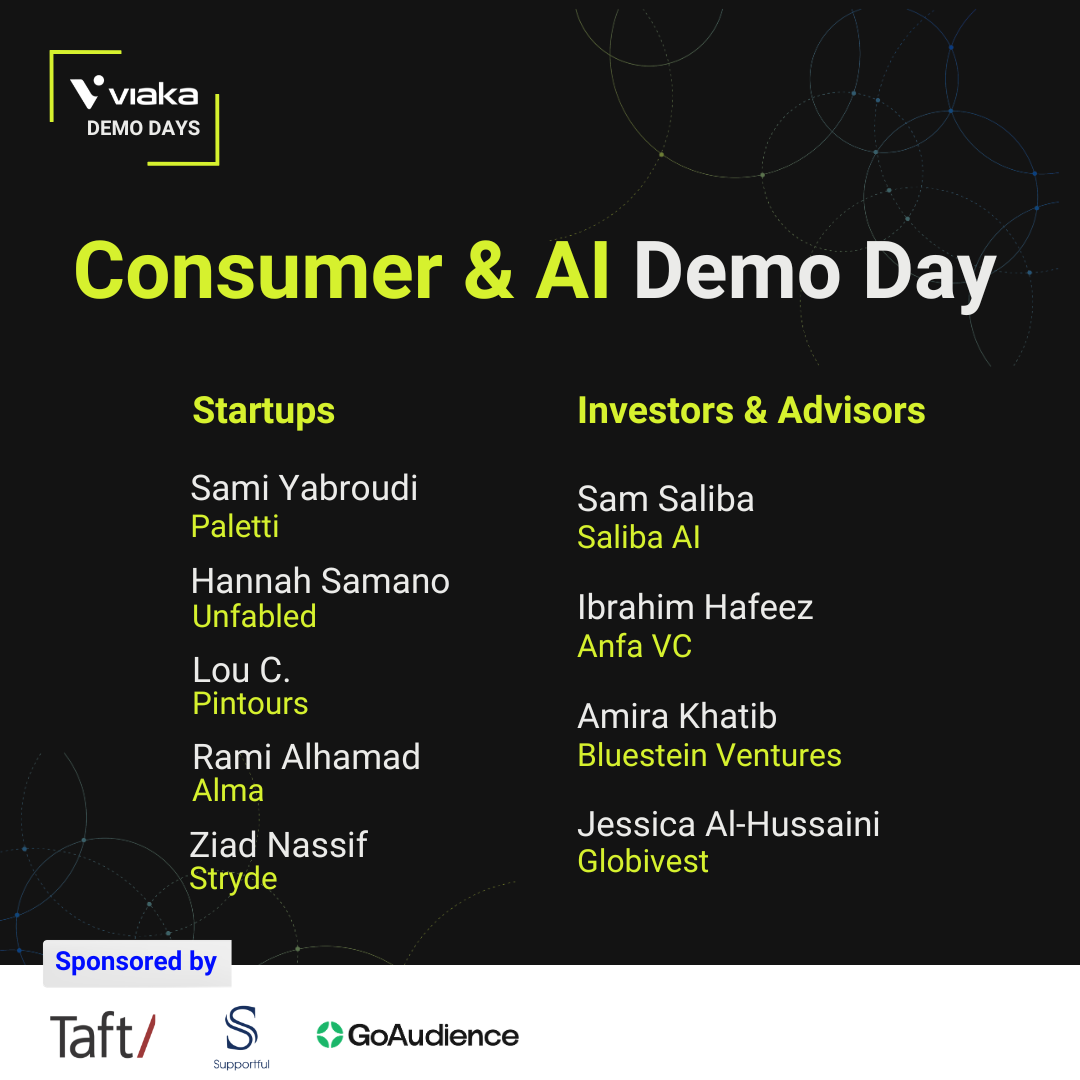
A Virtual Consumer & AI Demo Day: Featuring startups building at the intersection of consumer technology and AI, alongside insights from leading investors and advisors.
Sessions 3 and Session 4: We explored the realities of the angel-founder relationship after investment, from cap tables and SPVs to investor rights and expectations. You can listen to it here.
The Viaka Podcast: Reimagining Wealth Management with AI
In this episode of the Viaka Podcast, Karim Jouini, co-founder of Expensya, shares his journey building and scaling a global SaaS company from Tunisia to a $100M+ acquisition. The conversation explores entrepreneurship, leadership, scaling internationally, and lessons from building in the tech ecosystem.
Listen to the episode: Spotify | YouTube
Join our open Viaka Slack workspace today to connect, collaborate, and stay updated on upcoming events.
Empty Seats, Real Losses
By Rami Saab, Founder & CEO , Invictus Direct
When a role opens up, most companies default to the same playbook: post the job, collect applicants, and start interviewing.
But is that actually the right approach for every hire, or just the most familiar one?
One of the biggest misconceptions in hiring is that all searches should be run the same way. That’s seldom the case. A more junior or broad-based role may respond well to a job post and strong inbound flow. A specialized mid-level hire may require targeted database sourcing and tighter screening. But when the role is senior, highly niche, or business-critical, the search often needs a very different approach: targeted headhunting.
That difference matters more than many founders realize.
For example, a founder might say they need a “Senior Full Stack Engineer.” To the general public, that can sound straightforward. In practice, it could mean someone strong in React, Node.js, TypeScript, PostgreSQL, and AWS, with experience building scalable APIs, owning production infrastructure, working in lean teams, and ideally having startup or zero-to-one exposure. Add in healthcare compliance, fintech security, or marketplace architecture, and suddenly the talent pool narrows significantly. That person usually isn’t actively applying. More often, they’re already employed, performing well, and need to be identified, approached, and engaged in the right way.
That’s where expertise changes the outcome.
Hiring isn’t just about finding “a candidate.” It’s about knowing which search motion fits which role, how to position the opportunity, where the right people are likely to be, and how to get their attention. A niche search with a generic hiring strategy often creates the illusion that talent isn’t out there, when in reality the search itself is simply misaligned.
So the better question becomes: what does this specific hire actually require?
Is it a volume play? A focused sourcing exercise? Or a highly targeted headhunt?
And while the seat stays open, both evident and hidden costs start building.
The evident cost is easier to picture. If a role budgeted at $100K annually stays open, that represents roughly $385 of salary-equivalent capacity per workday, or about $11.5K over 30 workdays, $23K over 60, and $34.5K over 90. That’s a simple illustration of missing capacity.
But the hidden costs are often hard to keep front and center in mind, and more damaging: bandwidth issues, delayed launches, slower product cycles, missed sales momentum, overextended managers, and team members quietly absorbing work they were never meant to carry. Gem reported that hiring teams now conduct 42% more interviews per hire than in 2021, contributing to a 24% increase in average time to hire, from 33 days to 41 days. Longer processes don’t just test candidates, they test businesses too.
What happens when key work gets delayed for 60 or 90 days?
What slips, who gets stretched, and what momentum is lost while the seat stays empty?
If that strain contributes to turnover, the cost climbs again. Gallup estimates replacement costs at around 40% of salary for frontline roles, 80% for technical roles, and 200% for leaders and managers.
So the real question isn’t just: “How long has this role been open?”
Instead, it’s: “What has this vacancy already cost us, and are we using the right strategy to solve it?”
Sometimes the most expensive hire is the one you haven’t made yet.
Worth Checking Out
In Canada
Free FX for 3 Months — Airwallex
Our partners at Airwallex are offering Viaka Canada members 3 months of fee-free foreign exchange worth $2,000+ in savings for businesses with any cross-border payments activity.
If you’re interested, please reply to this email or reach out to Luna at luna@viaka.net.
In NYC
“Scale Beirut 26’: Where Capital Meets Impact” — American University of Beirut
Taking place on June 2, 6 PM - 9PM (ET) in Oasis 11, Midtown, Manhattan. RSVP here.
Follow us on LinkedIn, stay connected on Slack and subscribe to our event’s page.
Like what you’re reading? Don’t miss out — subscribe below to get the next one straight to your inbox.